The ride-hailing
glossary
in plain language
A practical reference for product, operations, finance, and technology terms. Definitions explain the concept without implying that every platform includes the feature.
Mobility teams often use the same word for different things. “Dispatch” might mean an algorithm, a dispatcher’s screen, or the entire process from request to assignment. Clear definitions make product reviews and contracts less ambiguous.
This glossary distinguishes general industry terms from Waslni’s actual product model. Waslni uses one role-aware mobile app for rider and driver journeys, offers permissioned quick administration inside the app, and provides the full administration experience on the web. App Experience can expose rides, delivery and shops, or both.
Payment availability, legal duties, tax treatment, store rules, and regulatory requirements vary by location and change over time. Confirm them with the relevant provider, authority, and qualified adviser rather than treating a glossary definition as operational or legal advice.
Terms from acceptance rate
to white-label
Use the anchor on any term when you need to reference its definition in a brief, scope, or product discussion.
- Acceptance rate
- The percentage of eligible trip offers a driver accepts during a defined period. The denominator and treatment of expired or cancelled offers must be stated before comparing rates.
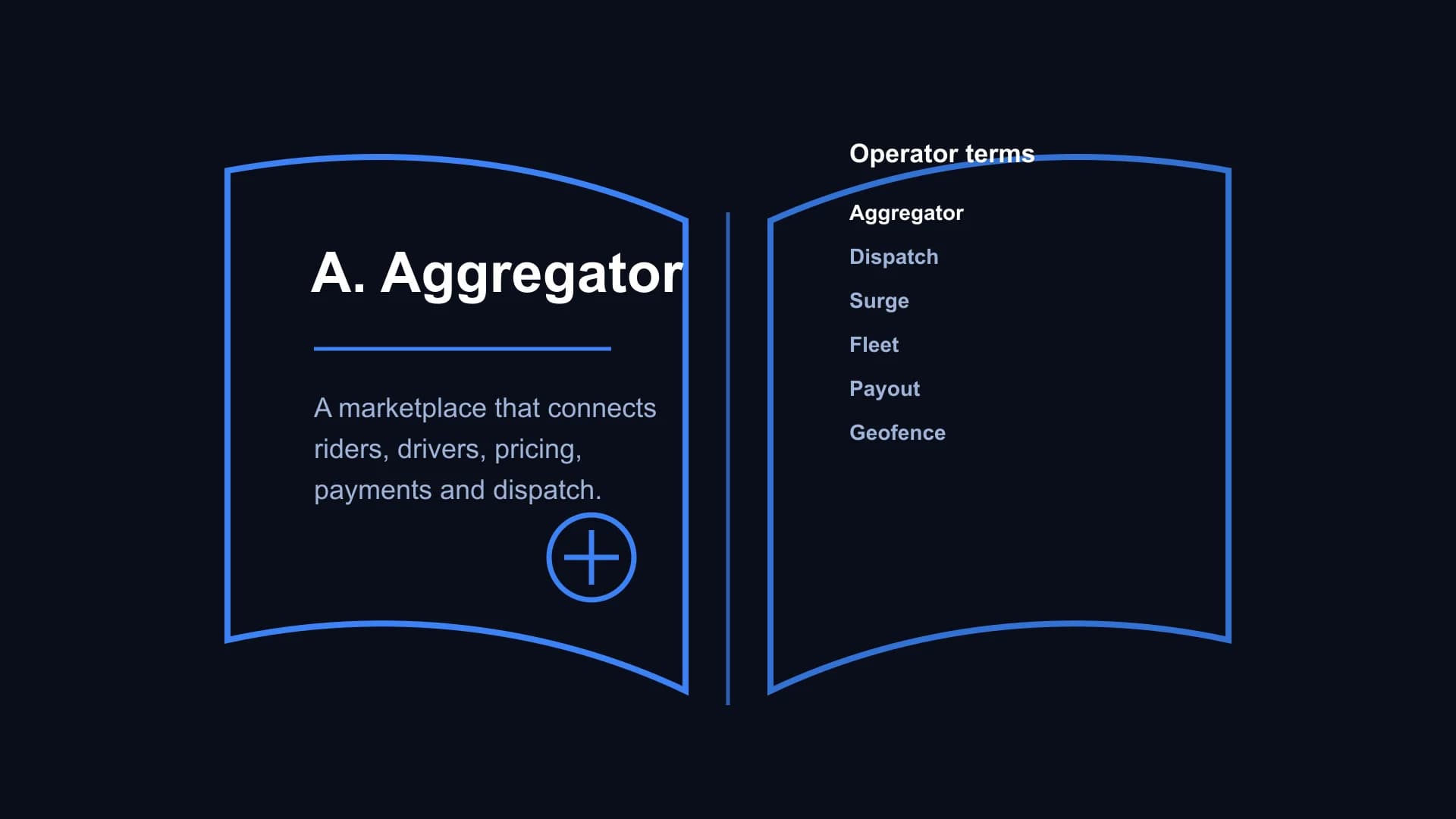
- Aggregator
- A service that connects demand or supply across more than one operator or platform. The exact role may include booking exchange, fleet connectivity, payments, or marketplace distribution.
- Admin panel
- The interface used by authorised staff to configure and govern the service. Waslni provides quick permissioned administration inside the mobile app and a fuller web admin panel for broader configuration and oversight.
- Base fare
- The starting amount in a fare calculation before distance, time, waiting, booking, toll, discount, tax, or other configured components are applied.
- Booking fee
- A separate charge associated with creating or processing a booking. Its name, calculation, disclosure, and tax treatment depend on the operator and local rules.
- Cancellation fee
- A charge that may apply when a rider or driver cancels after defined conditions are met. The trigger, amount, exceptions, recipient, and disclosure should be documented.
- Captain
- A regional customer-facing term for a driver. It does not change the person’s contractual, licensing, employment, or tax status.
- Commission
- The portion of a transaction retained or charged by a platform or operator under its commercial model. Always define the calculation base, taxes, adjustments, and payment timing.
- Completed trip
- A booking that reached the platform’s final completed state. Finance and analytics should document how disputes, reversals, cash trips, and later adjustments affect this status.
- Dispatch
- The process of matching a request with an available driver or vehicle. It may be automated, manually assisted, or fully manual, depending on the product and operation.
- Dispatcher
- An authorised staff member who monitors demand and supply and may create, assign, reassign, or support bookings where the system and permissions allow.
- Driver app
- The mobile experience used by a driver to manage availability and service requests. In Waslni this is a driver role within the same branded app used for the rider journey, not a separate installed app.
- Driver wallet
- A ledger or balance view associated with a driver account. Its entries may represent cash obligations, earnings, incentives, adjustments, or payouts, depending on the configured commercial process.
- Dynamic pricing
- Pricing that changes in response to defined inputs such as time, area, demand, or supply. The formula, safeguards, customer disclosure, and legal permissibility must be confirmed for each operation.
- ETA
- Estimated time of arrival. It is an estimate derived from location, route, traffic, and system assumptions, not a guaranteed arrival time.
- e-Hailing
- Requesting a vehicle electronically, usually through an app or web interface, rather than hailing it physically in the street or booking only by telephone.
- Fare formula
- The configured rules used to calculate a price, which may combine base, distance, duration, waiting, minimum, fixed, zone, discount, fee, and tax components.
- Fleet
- A group of vehicles managed as an operational unit. Ownership, driver relationship, dispatch control, maintenance responsibility, and settlement structure can vary.
- Geofence
- A virtual boundary represented by geographic data. A system may use it to control service availability, pricing, notifications, or operational rules.
- Heatmap
- A visual layer that represents the relative concentration of events such as requests, available drivers, or completed trips. Its meaning depends on the data and time window behind it.
- KYC
- “Know Your Customer”: processes used to collect and verify identity or business information. Required checks and permitted providers depend on the relationship, payment flow, and applicable law.
- Lahza
- A payment-services brand used in some markets. Availability in a platform, supported methods, settlement, fees, and merchant eligibility should be confirmed for the target country and account.
- LTV (Lifetime Value)
- An estimate of the economic value associated with a customer over a defined relationship period. State whether it means revenue, gross profit, or contribution after variable costs.
- mada
- A Saudi payment network. Acceptance depends on the merchant, acquirer, gateway, transaction type, technical integration, and current network rules.
- Multi-tenant
- An architecture in which one platform serves more than one operator or brand while separating their data and configuration. The isolation model and operational controls should be reviewed technically.
- MQTT
- A lightweight messaging protocol often used for frequent device or application updates. Using MQTT does not by itself guarantee real-time performance, security, or scalability.
- Operator
- The organisation responsible for running the mobility service and its commercial and operational relationships. Its legal duties depend on the jurisdiction and business structure.
- OTA update
- An over-the-air software update delivered to an installed app without a full store release where the technology and store policies allow it. Native changes still require a compatible app binary and may require store review.
- Peak hour
- A defined time window associated with higher demand or a different operating rule. It is schedule-based and should not be confused automatically with real-time dynamic pricing.
- Permission registry
- A central list of named administrative capabilities used to build roles and enforce access. A permission must be checked by the protected backend action, not only hidden in the interface.
- Promo code
- A code that applies a configured offer when its eligibility, time, usage, service, geography, and value conditions are met.
- Referral
- A programme that attributes a new user or action to an existing participant and may provide a reward. Qualification, abuse controls, accounting, and expiry should be explicit.
- Rider
- The person requesting or receiving the passenger-transport service. A rider may differ from the account holder, payer, or person who created the booking.
- RTL
- Right-to-left interface direction used by languages including Arabic and Hebrew. Proper RTL support covers layout, navigation, icons, mixed text, forms, charts, notifications, and generated documents—not translation alone.
- Service type
- A configured category such as a vehicle or fulfilment option with its own name, capacity, pricing, availability, and eligibility rules.
- SOS
- An emergency or safety action presented to a user. Its behaviour may call a number, share information, or alert a team; operators must document what it actually does and who responds.
- STC Pay
- A payment brand associated with Saudi Arabia. Merchant availability, accepted transaction types, settlement, fees, and technical support should be verified with the relevant payment provider.
- Surge
- An increase or multiplier applied to a price under defined conditions. The term is often used for demand-responsive pricing, but the exact formula and disclosure vary by system and market.
- Tenant
- A logically separated operator or brand within a multi-tenant platform, with its own users, settings, credentials, and data boundaries according to the architecture.
- TGA
- A commonly used English abbreviation for Saudi Arabia’s Transport General Authority. Operators should use the authority’s current official publications and qualified local advice for licensing and compliance requirements.
- Uber clone
- A marketing term for software that imitates familiar on-demand booking patterns. It says nothing by itself about code quality, licence rights, security, maintenance, scalability, or regulatory fit.
- Utilisation
- A measure of how much of an asset’s or driver’s available time is productively used. The formula must define availability, busy time, waiting, repositioning, breaks, and offline periods.
- VAT
- Value-added tax. Whether it applies, who supplies the service, who invoices, the rate, the tax base, and reporting duties depend on the transaction and applicable law.
- Wait fee
- A charge calculated for qualifying waiting time, usually after a defined event and any grace period. The rate, start, stop, exceptions, and disclosure should be configured clearly.
- Web booking
- A booking journey accessed in a web browser. It may serve passengers, business accounts, hotels, or call-centre staff, depending on the product.
- White-label
- A product presented under the operator’s brand while another company supplies some or all of the underlying technology. Branding, app accounts, code, data, infrastructure, and support rights are separate questions that the contract must answer.
White-label ride-hailing platform
See how the platform concepts fit together in an operating product.
How to start a ride-hailing business
Apply the vocabulary to planning and operations.
Platforms to review in 2026
Use a verification-led process to build your shortlist.
See the product model,
with your requirements
Review the unified rider-and-driver app, in-app administration, web panel, and App Experience settings in a live walkthrough.