Uber clone — buyer's guide

Looking for an
Uber clone?
Buy something better.

The Uber-clone-script market has been selling the same recycled codebase since 2017. Waslni is not in it. We are the hosted, MENA-first white-label ride-hailing platform that ships a real product in four weeks — and keeps shipping new features every quarter, to every tenant.

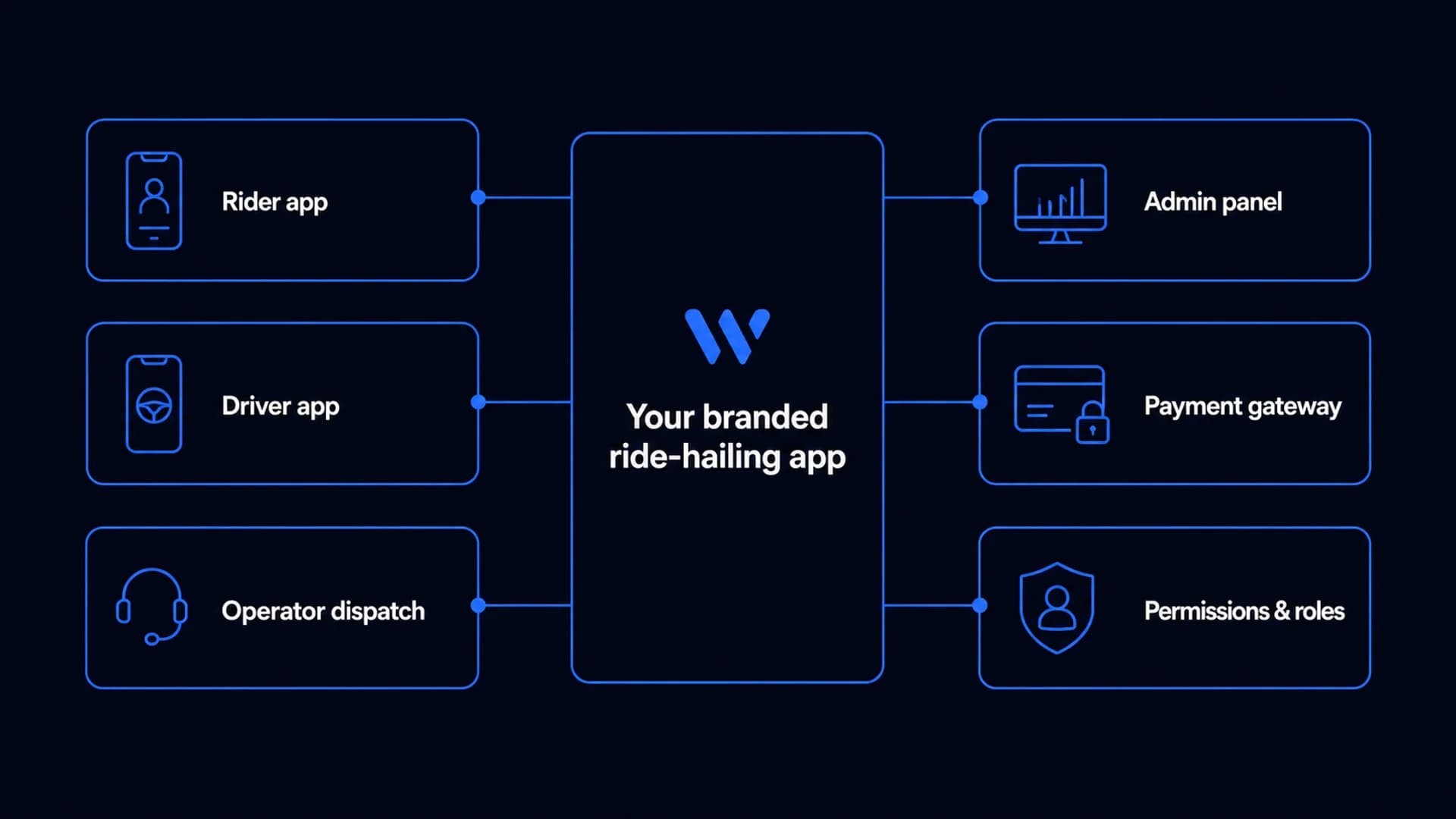
A platform-architecture diagram of a branded ride-hailing app and its component cards
4 wks
Launch timeline — not 4 months, not 4 quarters
40+
Per-tenant settings editable from the admin panel
8
Bundled languages including full Arabic RTL
4
MENA payment gateways live in production today
Last updated · May 202614 min readUber clone alternative

Most people searching for an "Uber clone" are not actually looking for an Uber clone. They are looking for a way to start a ride-hailing business without writing the platform from scratch. The clone-script market showed up to answer that question with a $4,999 license to a recycled codebase. It mostly does not work.

The reason it does not work is not that clones are evil. It is that ride-hailing is a real marketplace product, not a static app. A working ride-hailing service has to do live driver-to-rider assignment under contention, handle SOS calls, settle to four different payment gateways, file VAT, keep up with iOS privacy rules every September, and survive a sudden Friday-evening surge in Cairo. None of that is in the clone codebase, and all of it is your problem the day after you take delivery.

Waslni took a different approach. Build the platform once. Run it as a hosted SaaS. Let operators configure it per tenant down to the level of driver registration form fields and peak-hour pricing windows. Ship new features quarterly to every tenant. The clone-script question disappears because the right answer is not "buy a clone". It is "rent a real platform".

What you actually get when you buy an "Uber clone"

  • A copy of a React Native rider app — usually 18 months out of date.
  • A copy of a Flutter driver app — built against a different backend than the one shipped.
  • A "dispatch panel" that turns out to be a static Bootstrap admin theme with most buttons wired to nothing.
  • A backend that runs as a single Node.js process behind nginx — no MQTT broker, no real assignment logic, no monitoring.
  • One Stripe integration. No regional gateways. Cash payments handled by a column called isCash.
  • No multi-tenancy. To run a second brand, you fork the repo and double the infrastructure.
  • No Arabic. The phrase "we will localise it" appears in the contract.
  • Six months of email support, then radio silence.

None of that is hypothetical. We have rescued three projects that started with one of these scripts. The pattern is identical every time: the rider app works for the demo video, the driver app limps along, the dispatch panel never gets used, and by month nine the founding team is asking for a hosted platform to migrate to.

Customer app

The rider app
users expect in 2026

Every behaviour a rider would experience in Uber or Careem, shipped under your brand.

Booking

One-tap booking with a real fare quote

Address autocomplete with Google + Mapbox. Fare quote before booking, with surge multiplier and promo applied. Multiple saved payment methods, scheduled rides up to two weeks out, repeat-favourite addresses.

Safety

SOS, share-ride, and verified drivers

In-app SOS calls the local emergency number and notifies your operations team. Share-ride sends a live tracking link by SMS or WhatsApp. Riders see the driver photo, rating, plate number, and ID before pickup.

Payments

Cards, cash, wallets

Saved cards through Lahza, Fawry, Paymob, Kashier. Cash with automatic wallet reconciliation. Top-up wallet for prepaid customers. Promo codes and referral credits stack naturally.

Loyalty

Referrals and promo engine

Built-in referral codes with admin-defined rewards. Promo codes per city, per service type, per first-N-rides. Bonuses settle to rider wallet or as a fare discount.

Driver app

The driver app
drivers actually like

Smart assignment, transparent earnings, a heatmap that helps them earn more, and a compliance flow that does not feel hostile.

Workflow

Online toggle, smart assignment, navigation

Driver flips online, accepts or declines incoming requests based on radius + rating + load score, navigates with the embedded turn-by-turn map, completes the trip, and is auto-assigned the next nearest pickup.

Earnings

Earnings + wallet + weekly payouts

Real-time earnings counter. Daily, weekly, and lifetime totals. Cash trips deducted, card trips added, commission visible per trip. Weekly payout calendar with bank-transfer or wallet withdrawal.

Demand

Heatmap of where the rides are

Live demand heatmap updates every minute. Drivers see where to position themselves before peak. Reduces empty kilometres, increases utilisation.

Compliance

Document upload, expiry tracking

Drivers upload national ID, license, vehicle license, insurance, inspection — through the registration flow your admins compose. Expiring documents trigger automatic offline-mode and SMS reminders.

Operator + admin

The console
your ops team will live in

Dispatch, finance, drivers, riders, content, branding — one panel, with permissions so you can scale the team without scaling chaos.

Live dispatch

Live map + manual reassignment

Operators see every active driver and every active order in real time. Phone-booking shortcut for call-in customers. Manual reassignment for the awkward 1% of cases. Trip-history filter for follow-up.

Roles

Role-based permissions

Super Admin, Admin, Manager, Customer Service — each with a permission registry. Lock down who can edit fares, who can refund a rider, who can suspend a driver. Audit log records every change.

Service types

Service-type editor

Sedan, taxi, van, motorcycle, custom. Per-type pricing formula (per-km + per-min + base fare + minimum fare). Per-type peak-hour multipliers. Seat counts. All editable from the admin panel.

Finance

Finance reports + settlements

Daily, weekly, monthly revenue breakdown by service type, city, payment method. Driver commission report. Settlement runs export to CSV or trigger bank transfers via the gateway. VAT-ready receipts.

Content

Content CMS for legal + policy pages

Privacy, terms, rules, FAQ pages are editable from the admin panel. Multi-language. No deploy required to update copy.

Branding

Branding controls

Logo, brand colour palette, splash colour, push-notification sound, deep-link host, app name. Set once per tenant; applies across rider app, driver app, operator console, and admin panel.

Reliability

The boring parts
we got right

A clone-script rider app looks pretty in a screenshot. A production ride-hailing service has to survive Friday 8pm in Cairo. These are the parts that matter.

01

Multi-tenant isolation

Per-tenant database, per-tenant Redis namespace, per-tenant Cloudflare R2 path, per-tenant signing keys. Cross-tenant data access is structurally impossible — it is enforced at the connection-pool proxy layer.

02

Role-aware auth on every call

JWT tokens carry tenant + role claims. Every backend endpoint verifies both. Admin endpoints additionally check a permission-registry key. There is no "trust the client" path anywhere.

03

Real monitoring, not dashboards-for-show

Backend error rates, MQTT message latency, gateway failure rates, and driver online ratio are tracked per tenant. Alerts page the operations team before customers notice.

Side-by-side

Clone script
vs. Waslni

The honest comparison, with the trade-offs called out plainly.

Feature
Generic Uber-clone script
One-time licence, you maintain
Waslni
Hosted, MENA-first, configurable
Distribution model
One-time licence
Hosted SaaS
Ongoing maintenance
You
Waslni
Feature releases
Custom, you pay
Quarterly, included
iOS / Android SDK upgrades
You
Waslni
Native Arabic + RTL
Partial
Full
MENA payments (Lahza, Fawry, Paymob, Kashier)
Per-tenant configuration (fares, docs, roles, content)
Multi-tenant out of the box
Driver registration form is admin-composable
Permission registry with custom roles
Phone-booking shortcut for dispatchers
Add-on
OTA updates for the mobile apps
Realistic launch time
3–9 months
4 weeks
Source-code escrow / vendor-lock risk
High
Low — data export documented
Common questions

From operators
comparing clone scripts

01 /

Is Waslni an Uber clone?

Not in the sense the clone-script market uses the term. A clone is a one-time-licensed lookalike codebase that becomes your maintenance problem on day one. Waslni is a hosted multi-tenant ride-hailing platform: branded rider and driver apps in your stores, an operator console for dispatchers, an admin panel for your operations team — and we run the backend. The product behaviour matches Uber; the cost structure and the maintenance burden do not.

02 /

Why is a clone script a bad idea?

Three reasons. First, the typical clone uses an outdated React Native or Flutter version that breaks the next time Apple changes a privacy rule. Second, the backend is rarely production-grade — single-process, no MQTT broker, no real driver assignment logic, breaks at 50 concurrent rides. Third, you carry the maintenance forever: SDK upgrades, gateway changes, App Store policy churn, security patches. Most clones are abandoned by month nine.

03 /

How is it priced?

Monthly platform fee plus a small per-completed-trip fee. The per-trip fee covers backend infrastructure, OTA updates, Apple/Google account costs, and platform engineering. Payment processing fees are passed through from your gateway. A 14-day free demo lets you drive it before committing.

04 /

Can I customise the apps beyond branding?

Yes. Service types and fares, peak windows, driver documents, registration form fields, role permissions, banners, homepage layout for shops, policy pages — all editable from the admin panel. For deeper customisation (a new service type with unique behaviour, a regulator-specific receipt format), we run it through a quarterly platform-feature pipeline.

05 /

What if I want to leave?

We document a data-export path: drivers, riders, trips, transactions, documents — all exportable to CSV or to a database dump. You keep your published apps under your developer accounts. We do not believe in vendor lock through obscurity.

06 /

How big can it scale?

The production stack runs Node.js / Fastify on the API + an MQTT broker (aedes) on the same process, with MySQL primary + Redis for cache and pub-sub, hosted in a regional cloud. The two production tenants today carry low-thousands of daily trips with headroom; the architecture scales to tens of thousands without redesign by adding read replicas and horizontal API workers.

Decide it for yourself

Drive the real product.
Not a marketing demo.

Free demo for 14 days. Real rider + driver apps install on your phone. Real admin panel opens in your browser. No card required.

Uber clone — what to buy in 2026 (Waslni)