25%
Critical workflows
Run the same rider, driver, dispatch, support, finance, and exception scenarios with your configuration.
This is a vendor shortlist, not an objective league table. Capabilities, prices, integrations, and market coverage change, so every claim should be demonstrated and written into your scope.
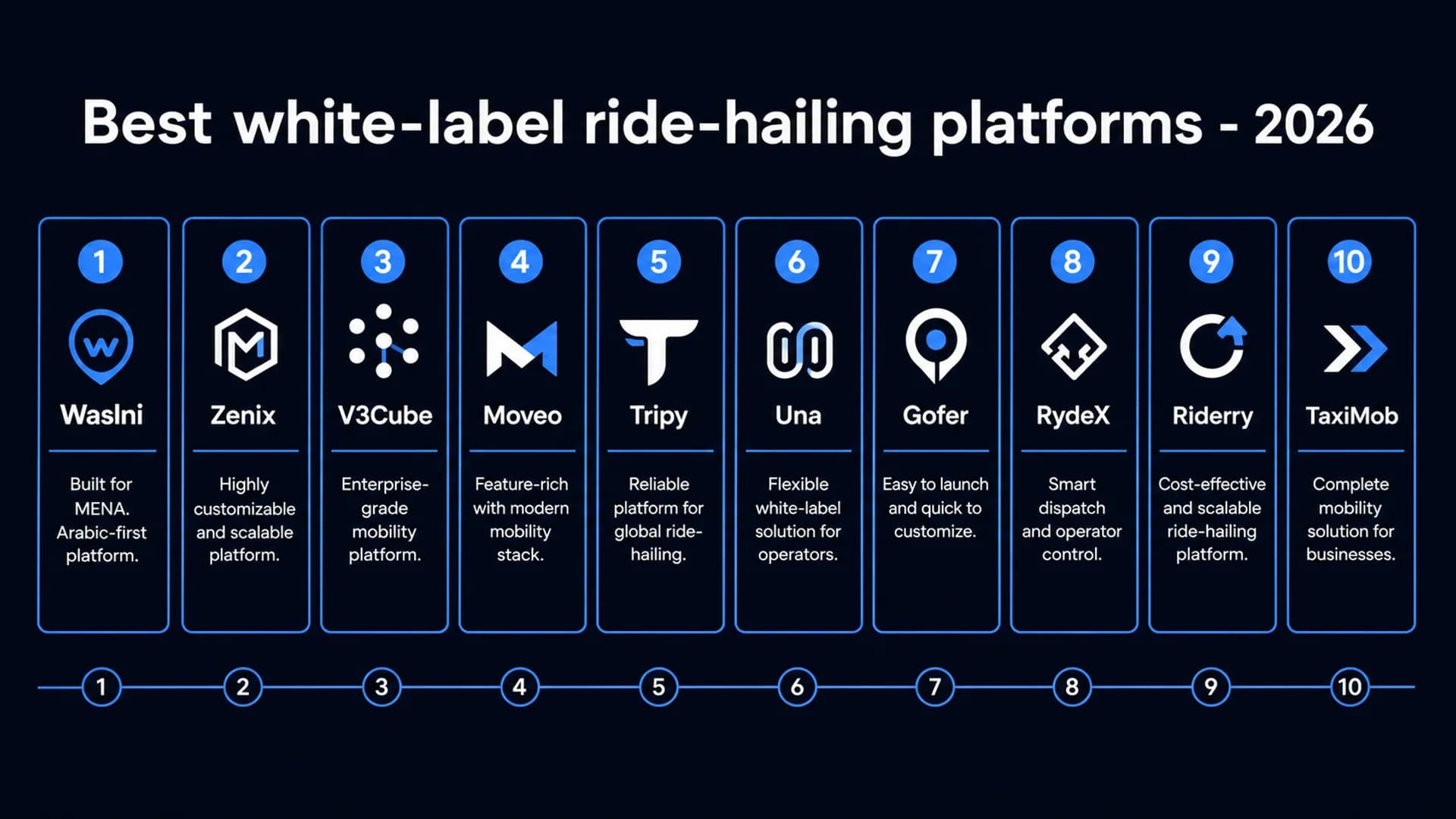
No vendor can be declared the best white-label ride-hailing platform for every operator. A taxi fleet, a new marketplace, a chauffeur company, and a delivery-led super app have different users, processes, regulations, integrations, and economics.
Waslni publishes this guide and is included first, so treat it as a transparent vendor-authored shortlist rather than an independent ranking. The numbered order helps navigation; it is not evidence that one competitor is universally better than another.
For each vendor, ask to see the full rider, driver, support, dispatch, finance, permissions, and reporting journeys relevant to your operation. Verify current pricing, support coverage, app-store ownership, data export, security responsibilities, payment availability, local legal fit, and exit terms directly with the vendor.
Set weights before demonstrations, record the evidence link and reviewer, and mark an item unavailable when it is neither demonstrated nor committed in the signed scope.
Run the same rider, driver, dispatch, support, finance, and exception scenarios with your configuration.
Verify languages, RTL, currency display, maps, payments, documents, tax treatment, and regulator responsibilities.
Review access control, incident handling, update process, dependency practices, backups, and independent evidence where available.
Require a working demonstration or documented API and named implementation owner for every dependency.
Record store ownership, data export, service levels, change control, termination assistance, and recurring obligations.
Compare the same years, usage, modules, integrations, internal labour, variable services, and migration assumptions.
The “strengths” below are areas to ask vendors to demonstrate. The watch-outs are diligence questions, not findings of misconduct or product failure.
Configurable ride-hailing and delivery platform
Operators who want Arabic and RTL support, a unified rider-and-driver app, configurable services, and both mobile and web administration.
Shortlist whenThe demonstrated Waslni workflows match your operating model and the contract covers your integrations, data, support, and exit requirements.
Read comparisonWhite-label mobility software
Operators comparing established white-label mobility products across several markets.
Shortlist whenIts live product, local integrations, commercial model, and support arrangement fit your launch better than the alternatives.
Read comparisonTaxi dispatch and fleet technology
Established taxi businesses evaluating dispatch-led products and integrations with their existing operation.
Shortlist whenYour priority is dispatch-led taxi operation and the demonstrated deployment model fits your organisation.
Read comparisonPrivate-hire and taxi technology
Private-hire and taxi operators comparing dispatch, booking, network, and fleet-management workflows.
Shortlist whenIts private-hire workflow and available network connections align with your actual operation.
Read comparisonOn-demand software platform
Teams exploring a mix of ride, delivery, or other on-demand service models.
Shortlist whenThe current package covers your required services without depending on uncommitted roadmap work.
Read comparisonTaxi and delivery software
Operators comparing ride and delivery workflows within one vendor offering.
Shortlist whenThe live combined-service workflows and commercial structure fit the way you plan to operate.
Read comparisonCloud taxi dispatch software
Taxi fleets that want to compare cloud dispatch and booking tools with their current processes.
Shortlist whenThe tested dispatch workflow and plan limits suit your fleet and growth assumptions.
Read comparisonWhite-label taxi and dispatch software
Operators seeking another configurable taxi and white-label option for comparison.
Shortlist whenThe specific implementation team and demonstrated package satisfy your operational checklist.
Read comparisonMobility software platform
Operators whose plan includes shared vehicles or other mobility models alongside, or instead of, booked rides.
Shortlist whenIts demonstrated mobility model—not merely the category label—matches your primary business.
Read comparisonChauffeur and transportation software
Buyers comparing chauffeur, premium transport, or fleet-oriented software with mainstream ride-hailing platforms.
Shortlist whenIts demonstrated premium, chauffeur, or fleet workflow fits your customer and fulfilment model.
Read comparisonThere is no defensible universal winner. The best fit depends on service model, geography, regulation, languages, payments, integrations, internal team, contract, and budget. Use this list to create a shortlist, then score live demonstrations and written proposals against the same requirements.
At minimum, review the rider and driver journeys, dispatch and service controls, pricing, registration, documents, support, permissions, reporting, security, payments, notifications, data handling, and release ownership. In Waslni, rider and driver journeys share one role-aware app; quick admin is available in-app and full admin on the web.
Pricing changes by vendor, modules, usage, integrations, implementation, and support. Request current written proposals using the same volume and scope assumptions. Include payment fees, messaging, maps, store accounts, custom work, migration, and internal operating costs.
Use the same scripted demo for both. In Waslni, test the unified rider-and-driver app, in-app operational administration, full web admin, roles and permissions, dynamic registration, service settings, and App Experience modes. Then compare security, integrations, support, data, price, and contract terms.
No. It is a Waslni-authored buyer guide, not an independent certification. Competitor products and terms can change. Any purchase decision should rely on the vendor’s current documentation, a live demonstration, technical and legal review, and a signed scope.
Review the unified app, mobile and web administration, App Experience, integrations, and any gaps that need written scope.