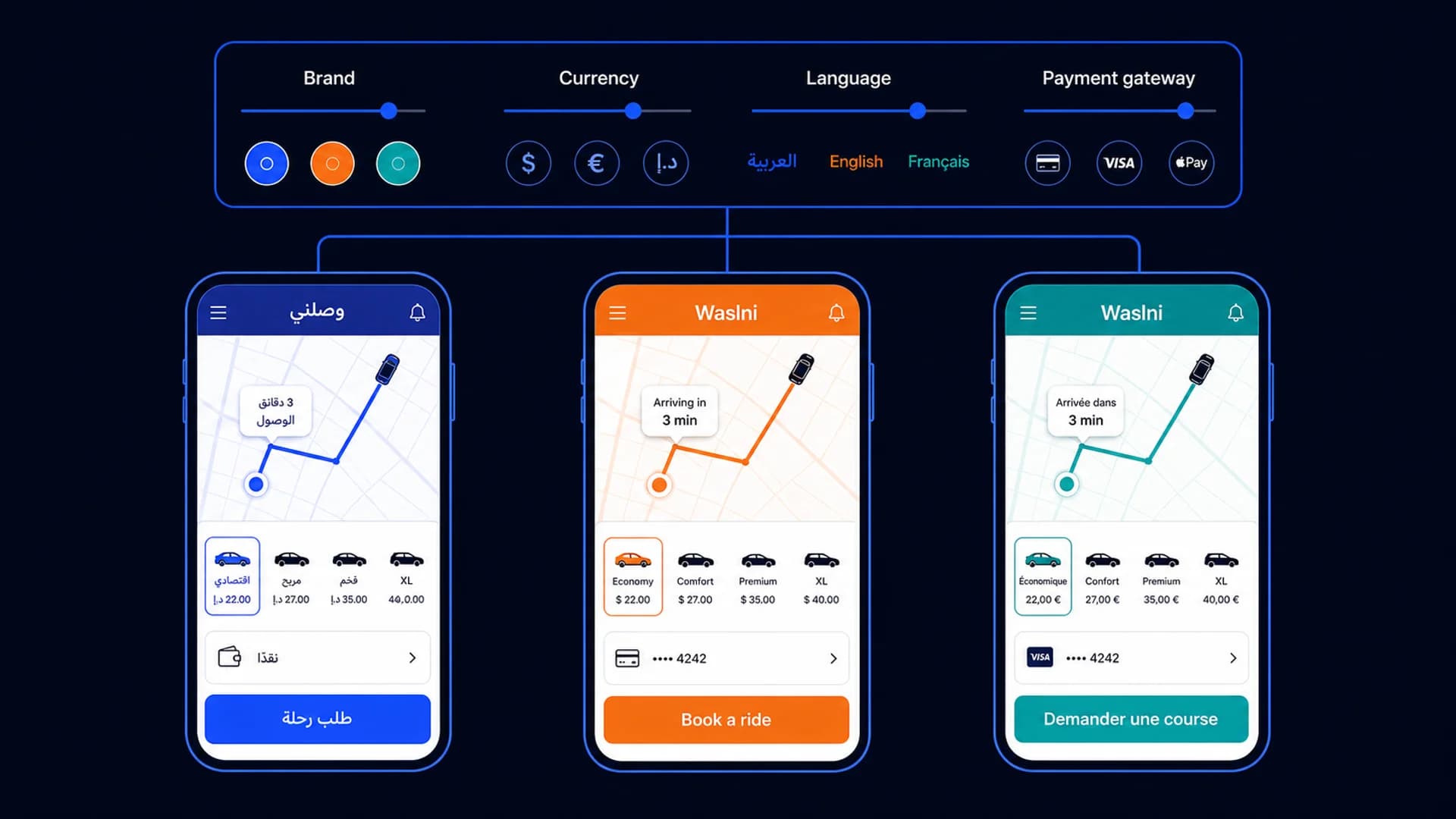
White-label ride-hailing platform

One platform.
Every brand.
Configured per tenant.

Waslni is the white-label ride-hailing platform built where Arabic-first UX, regional payments, admin-configurable product behaviour, and a four-week launch are the starting point, not a roadmap promise.

Three phones running the same ride-hailing app in different brands and languages
1
Codebase, two production countries running side-by-side
8
Languages including Arabic, with RTL admin and apps
40+
Per-tenant settings editable without code deploys
4 wks
Standard launch timeline from kickoff to App Store
Last updated · May 202610 min readWhite-label platform

White-label is one of the most abused words in B2B software. It usually means a re-skin — same product, different colour, same vendor name buried in the footer of a receipt PDF.

That definition was good enough when the product was a salon booking calendar. It is not good enough when the product is a ride-hailing service that has to settle thousands of payments per day, dispatch drivers in real time across a city, file VAT in two currencies, and absorb the unique fact that one of your drivers just had their car towed. A real white-label ride-hailing platform has to do the boring parts of being a marketplace operator out of the box.

Waslni was built on two stubborn opinions. First, the platform should run as a hosted multi-tenant SaaS, because the alternative — every operator owning a fork of an ageing codebase — is how most clones die in year three. Second, configuration should reach deep enough into the product that operators can change service types, fares, peak hours, document requirements, registration form fields, role permissions, and policy copy without opening a ticket. Everything else follows from those two decisions.

Four pillars

What 'white-label'
actually means
when you ship it

Most platforms claim white-label and ship a re-skin. These are the four lines that separate a real white-label platform from one.

01

It is genuinely your brand

Logo, palette, app name, bundle ID, deep-link host, splash colour, push sound, store metadata, marketing email templates — all per-tenant variables. Two Waslni-powered apps will not look like siblings unless their operators want them to.

02

Admins change product behaviour, not engineers

Service types, fares, peak windows, driver document checklist, registration form fields, role permissions, banners, terms of service, OTP providers — all editable from the dashboard. Engineering ships product, not config tickets.

03

Arabic is a first-class language

Right-to-left layout is verified on every screen in every app. Receipts, push notifications, SMS bodies, admin panel — all bilingual. Translations include AR, EN, RU, TR, DE, FR, UK, and HE.

04

Regional payments are first-class too

Lahza, Fawry, Kashier, Paymob in production today. Adding mada, STC Pay, MyFatoorah, HyperPay, or any regional gateway is a tenant-config exercise, not a rebuild. Cash and wallets are also wired in.

What you ship on day one

A complete
ride-hailing stack

Three connected products that have to be in sync in real time. Waslni ships all three from the same codebase, integrated, tested together.

Rider

Rider app for iOS and Android

Native React Native build via Expo. Phone-OTP signup, address autocomplete, fare quote before booking, scheduled rides, in-app chat, SOS, ratings, saved payment methods, referrals, promo codes, ride history, and Arabic RTL. Published under your developer accounts.

Driver

Driver app for iOS and Android

Online toggle, smart assignment based on proximity + rating + load, turn-by-turn navigation, earnings + wallet, weekly payouts, document upload with admin review, demand heatmap, and per-tenant onboarding fields. Drivers can self-register; admins approve.

Operator

Web dispatch + admin panel

Live map of drivers and orders, manual reassignment, phone-booking shortcut for call-in customers, ride history with filters, financial reports, role-based permissions, content management for policy pages, banners and homepage layout for shops, and a service-type editor.

Platform features

What is in the box

The features below are not on a roadmap. They are running in production for two operators in two countries today.

Multi-tenant

Run one brand or many

The same Waslni cluster can power multiple operator brands at once. Per-tenant databases, per-tenant Redis namespaces, per-tenant Cloudflare R2 paths, per-tenant signing keys. Cross-tenant access is impossible by design.

Permissions

Real role-based access

Super Admin, Admin, Manager, Customer Service out of the box, each with a granular permission registry. Build custom roles by toggling permissions. Audit log captures who changed what.

i18n

Eight languages, with content control

Policy, terms, rules, and onboarding copy are CMS-managed. Your team writes the text once per language; the apps render the right one from the device locale.

Compliance

Driver KYC + document workflows

Configurable per-country document list. National ID, license, vehicle license, insurance certificates — define them in the admin panel and the rider/driver registration flow updates automatically.

Onboarding

Self-serve driver registration

Drivers register from the app, upload documents, and your team reviews from the admin panel. The form is admin-composable: add new fields by type (image, text, select, color, car model) without shipping code.

Releases

OTA updates for the mobile apps

JavaScript-side fixes ship to users in minutes via Expo Updates. Native binaries are recut quarterly. You never ask users to update for routine improvements.

Buy vs. build

Generic SaaS vs.
Waslni

Most ride-hailing SaaS started in another region and was retrofitted to MENA. Waslni was built where the operators are.

Feature
Generic ride-hailing SaaS
The category average
Waslni
MENA-first, hosted, configurable
Hosted vs. you-host-it
You host
We host (multi-region)
Per-tenant config without code
Limited
Yes — service types, fares, docs, forms, roles, content
Arabic UI in app + admin + emails
Partial
Full
MENA payment gateways out of the box
Multi-tenant (one cluster, many brands)
White-label apps in your stores
Sometimes
Yes — your developer accounts
New features shipped quarterly to all tenants
Custom build per tenant
Yes — single codebase, OTA-delivered
Realistic time to first live ride
3–9 months
4 weeks
Launch timeline

Four weeks.
In production.

The same playbook we used for Palestine and Egypt. No surprises.

01 /
Week 1

Brand + tenant provisioned

You send us your brand kit; we provision the tenant: database, Redis namespace, R2 storage path, subdomain, admin account, currency, default language. The skeleton app is up the same week.

02 /
Week 2

Operations configured by your team

Your operations lead spends a couple of days in the admin panel: service types, fares, peak-hour windows, document checklist, cities, geofences. The product behaves like yours by Friday.

03 /
Week 3

Payments + compliance live

Payment gateway merchant accounts plug in under the keys you control. KYC for drivers is reviewed against local regulations. Privacy + terms are localized.

04 /
Week 4

Store launch

Builds submitted to App Store + Play Console under your developer accounts. 50-driver TestFlight pilot validates dispatch. Public launch within 24 hours of approval.

Questions operators ask

Honest answers.
Not sales answers.

01 /

What does "white-label" mean on Waslni?

It means the rider and driver apps are published in the App Store and Google Play under your developer accounts, with your name, your logo, your colours, and your bundle ID. The admin panel sits on a subdomain you choose. No Waslni branding is visible to your users or drivers. From their perspective, the product is yours.

02 /

How is this different from buying an Uber clone?

A clone script is a one-time code delivery. You then maintain the servers, the security patches, the iOS / Android SDK upgrades, the payment gateway API churn, and the bug fixes — forever. Waslni is a hosted platform. We run the infrastructure, ship new features quarterly to every tenant, and you focus on operating the business.

03 /

Can I edit fares and service types without engineers?

Yes. The admin panel has dedicated editors for service types (car, taxi, van, motorcycle, custom), pricing formulas per service type and per city, peak-hour multipliers with multiple windows per day, and seat-count rules. Changes take effect immediately.

04 /

Which payment gateways are supported in MENA?

Lahza is live in Palestine and Egypt. Fawry, Kashier, and Paymob are live in Egypt. For Saudi Arabia, HyperPay + mada + STC Pay are the typical stack — these are tenant-config integrations, not platform-level engineering. For the UAE, Telr / Network International / Checkout.com follow the same pattern.

05 /

Do you support Arabic in the admin panel too?

Yes. Every admin screen is fully translated and rendered right-to-left when the operator picks Arabic. Email and SMS templates are bilingual. Print receipts render correctly in Arabic.

06 /

What about the source code? Do I own it?

You own your data, your brand, your tenant config, your driver and rider relationships, your accounts, and your published apps. You do not own the platform source code — that is a hosted SaaS. The trade-off is that every new feature we ship lands on your tenant automatically, and you never carry the security and maintenance burden of running a ride-hailing backend.

See it for yourself

A real demo tenant,
provisioned in minutes

14 days free. Apps install on your phone. Admin panel opens in your browser. No card required.

White-label ride-hailing platform — Waslni