Build an app
like Uber Eats
around the real operation
Start with the order lifecycle: merchant acceptance, preparation, courier assignment, pickup, live tracking, delivery, support, and settlement—then choose how much software you truly need to build.
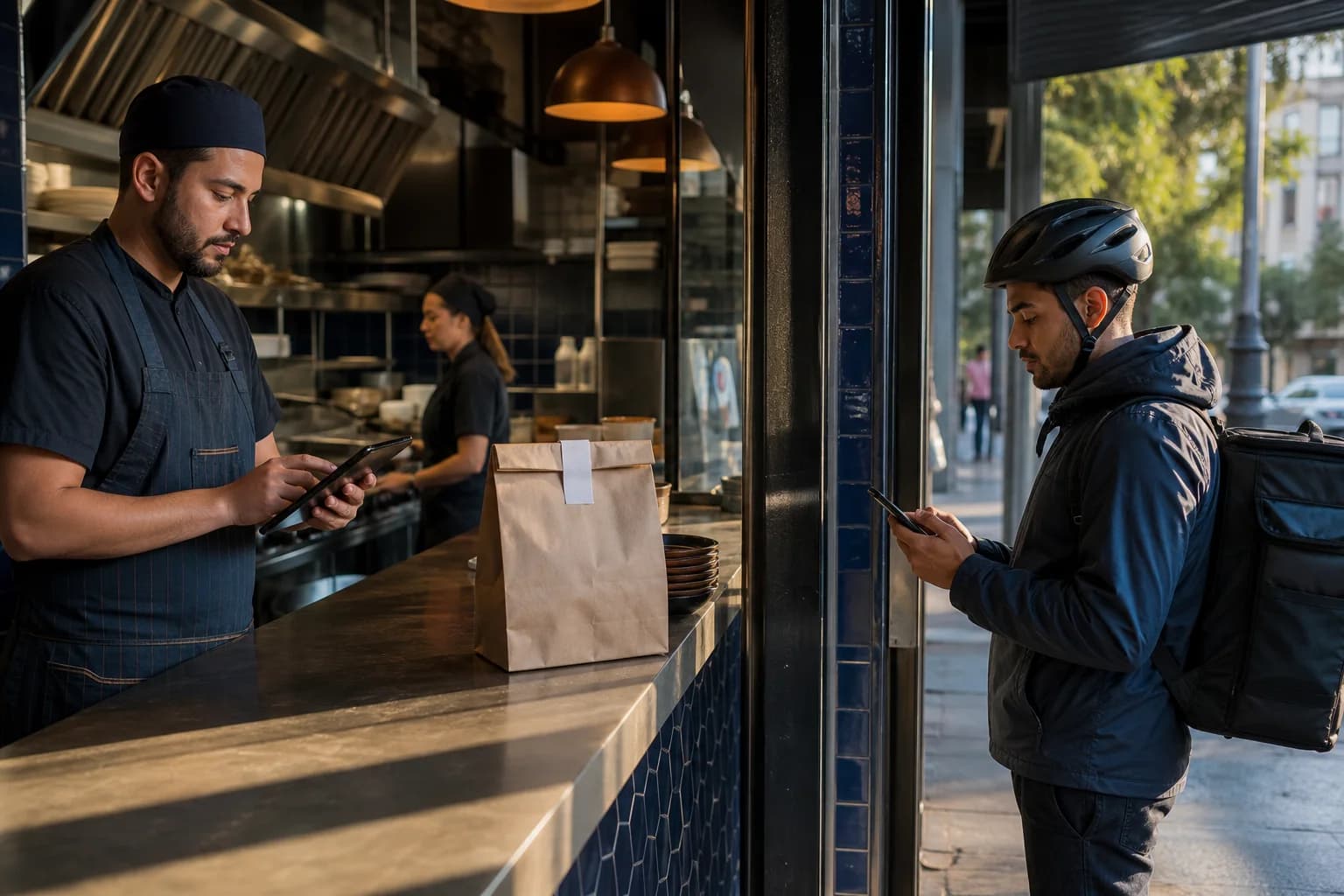
The hardest part of a food delivery product is not showing restaurants on a map. It is preserving a reliable chain of commitments while several independent parties act at different speeds. The customer expects certainty, the kitchen manages capacity, the courier protects earning time, and support inherits every mismatch.
An app “like Uber Eats” should mean workflow inspiration, not copying protected branding, proprietary software, or a company’s exact operating model. Your version needs to reflect your service promise, merchant contracts, courier model, payment environment, and support capacity.
Waslni brings these workflows into one role-aware mobile app for customers, drivers or couriers, shop owners, and authorized operational staff, plus a full web admin panel. App Experience can expose food and shops with delivery, rides, or both. Tracking, coupons, catalogs, and supported payment providers are configured around the operating model.
Design every state
and every owner.
A status is useful only when it tells each participant what has happened, what happens next, and who is accountable for moving the order forward.
Checkout validates the promise
Before confirming, validate the delivery address, merchant availability, basket, modifiers, fees, coupon rules, payment method, and estimated service conditions. Do not accept an order the operation cannot see or serve.
The merchant accepts or rejects
Send a clear order with items, modifiers, notes, payment status, and expected response window. Rejection needs a reason so the customer, support team, and operator can recover appropriately.
Preparation becomes observable
The merchant confirms preparation progress and updates the estimate when needed. Dispatch should use a practical pickup target so the courier is neither late nor waiting unnecessarily.
A courier is assigned
Matching considers eligibility, availability, pickup distance, active workload, zone rules, and the operator’s dispatch policy. Provide manual assignment and reassignment for cases automation cannot resolve.
Pickup transfers custody
The courier reaches the merchant, identifies the correct order, confirms collection, and records any wait or problem. The system now changes responsibility from preparation to delivery.
Live tracking explains progress
Show the customer a useful status and courier movement without pretending GPS is perfect. Give support and dispatch richer context, including last update time and contact history.
Delivery closes fulfilment
Confirm arrival and completion using the proof appropriate to your market and service. Handle recipient contact failure, safe-location rules, cash collection, and unsuccessful delivery explicitly.
Settlement closes the money flow
Record charge, cash, fee, commission, courier earning, merchant receivable, refund, adjustment, and payout state. An order is not operationally complete while its money remains unexplained.
The product earns trust
when the plan breaks.
Write exception playbooks with ownership, communication, allowed actions, and financial consequences before the support queue fills.
Preparation runs late
Refresh the estimate, decide whether the courier should wait or be reassigned, notify the customer honestly, and record merchant delay separately from courier travel.
The basket must change
Define substitution, removal, customer approval, repricing, and refund rules. Never leave the merchant and support team to invent a financial policy during a live order.
Assignment fails
Retry matching, expose the order to dispatch, set escalation timing, and decide when a customer should receive a revised promise or cancellation option.
The handoff point is unclear
Give courier and customer controlled contact options, preserve privacy, capture location notes, and define how long a courier waits before support intervenes.
The order cannot be completed
Support needs proof, contact history, custody status, payment context, and policy-guided actions for return, cancellation, redelivery, or refund.
One case owns the recovery
Keep a timeline of status changes, messages, reassignment, refunds, and staff actions. Customers should not have to retell the order history to each support agent.
Choose where your advantage
actually lives.
Compare the complete ownership burden, not just the first release. Software is one part of a delivery company; merchant supply, courier operations, support, and local economics remain yours either way.
| Decision factor | Build a custom platform | Configure a ready platform |
|---|---|---|
| Best fit | A proven, materially unusual operating model that existing platforms cannot support | A standard marketplace or delivery workflow differentiated mainly by execution, brand, supply, and market focus |
| Initial responsibility | Product discovery, architecture, apps, backend, dispatch, security, infrastructure, QA, release, and operations | Branding, service configuration, integrations, merchant and courier setup, policies, training, and launch operations |
| Change control | Direct control, limited by your engineering capacity and accumulated system complexity | Configuration plus vendor-supported product evolution; bespoke changes depend on platform scope and agreement |
| Ongoing burden | Hiring, incident response, store compatibility, security maintenance, mapping, payment upkeep, and feature development | Vendor management, configuration governance, integration upkeep, operational training, and subscription or licensing cost |
| Key risk | Spending operational runway before the product and workflow become dependable | Selecting a platform that cannot support a genuinely essential workflow or acceptable data/exit terms |
| Evidence to demand | A funded team, validated requirements, delivery roadmap, security model, and long-term maintenance plan | A working demo, scope matrix, implementation plan, support terms, data policy, integration detail, and clear commercial terms |
Build only what
creates durable leverage.
These questions keep the decision tied to evidence rather than the appeal of owning code or the speed of buying software.
Is the workflow truly unique?
Name the capability a ready platform cannot provide and why customers, merchants, or couriers will value it. Branding and familiar marketplace states are not a unique technical model.
Can you fund ownership?
Model product, engineering, infrastructure, security, QA, releases, integrations, support tooling, and maintenance alongside the operating capital needed to launch the marketplace.
Can you operate the software?
The team must handle incidents, store changes, payment failures, map issues, notification delivery, privacy requests, security updates, and product improvement after launch.
Can you verify the alternative?
For a vendor, test the real workflow and inspect scope, support, data, and exit terms. For an internal build, validate requirements and delivery capacity before treating the roadmap as certain.
Questions to answer
before development starts.
What does an app like Uber Eats need at minimum?
A viable operation usually needs customer ordering, merchant acceptance and menu control, courier assignment and delivery work, admin or dispatch oversight, order status communication, payments or cash handling, support tools, and financial reconciliation. The exact first release should follow your service model.
Should courier assignment happen before or after food preparation?
There is no universal timing rule. Assignment should account for expected preparation, courier travel, supply conditions, and your service promise. The practical goal is to reduce both late pickup and unpaid courier waiting, with dispatch able to intervene.
How should live tracking be presented?
Show a clear order status, an appropriate courier location view, and honest estimates. Account for delayed or noisy GPS updates. Support and dispatch should see last-update timing and richer operational context than the customer needs.
When is building from scratch justified?
It is easier to justify when a validated, essential workflow cannot be supported by available platforms and you have the funding, product leadership, engineering team, security capability, and long-term maintenance commitment to own the complete system.
Can Waslni combine delivery with rides or shops?
Yes. App Experience can present rides only, shops and delivery only, or both. Customers, drivers or couriers, shop owners, and authorized staff use role-appropriate areas of the same mobile app, while the full web panel handles configuration and oversight.
Plan a Talabat-style MENA launch
Structure the customer, restaurant, courier, and operator model with Arabic-first local execution.
Start a local delivery app business
Compare service categories, model unit economics, and move through an eight-step launch.
Read the wider build-vs-buy framework
Examine ownership, maintenance, product control, and operating focus in more depth.
Put the order lifecycle
in front of your operators.
Explore how Waslni connects customer ordering, merchant preparation, courier delivery, dispatch, tracking, payments, coupons, and menus under your brand.