Build a food delivery app
like Talabat
for your own market
Use the marketplace workflow as inspiration: connect customers, restaurants, couriers, and your operations team under your own brand, commercial model, and local rules.
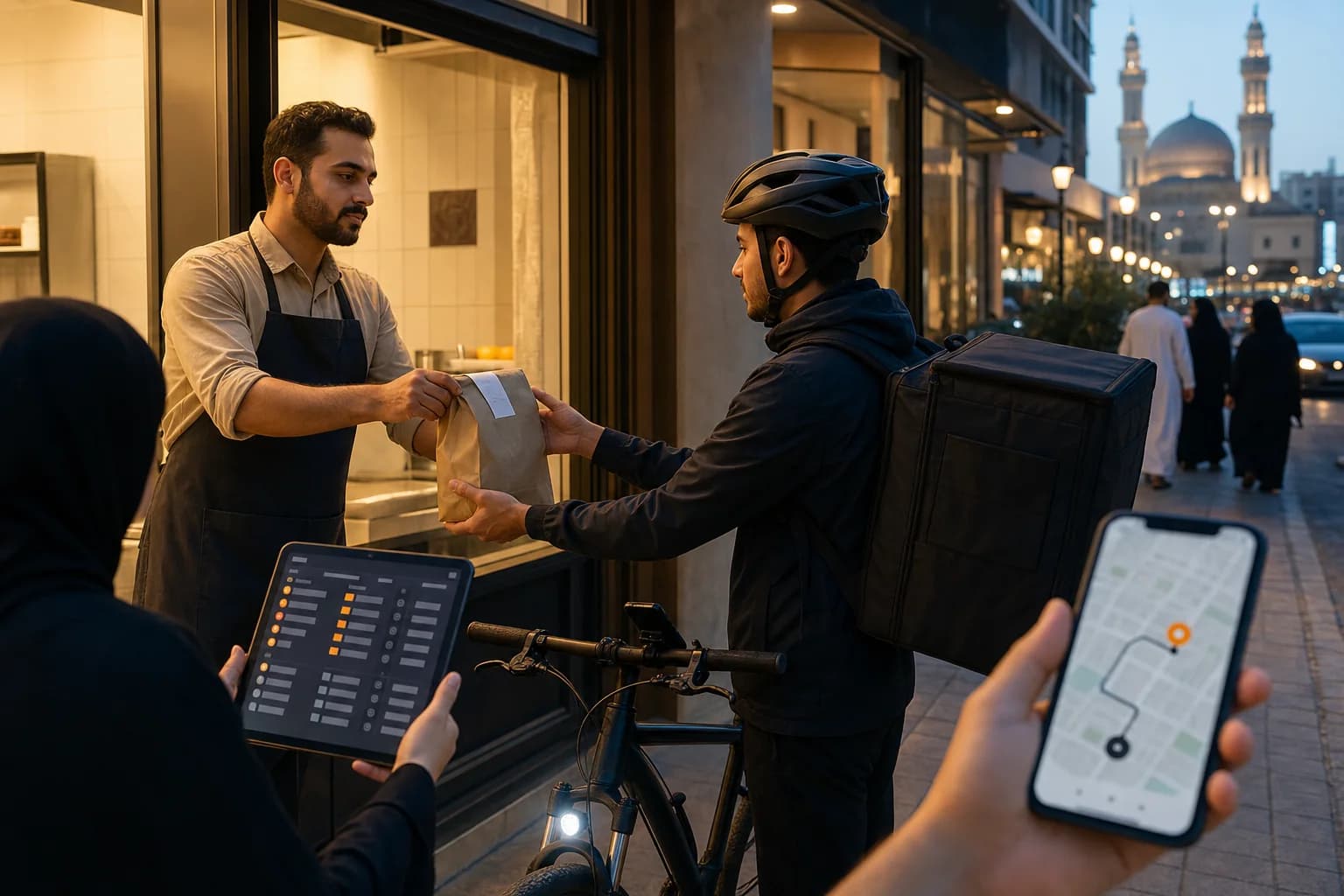
A successful MENA marketplace is not just a restaurant directory with a checkout button. It is a four-sided operating system: customers need dependable ordering, restaurants need manageable incoming demand, couriers need clear work, and operators need control when reality departs from the happy path.
“Like Talabat” should describe workflow inspiration—not a visual copy, code copy, endorsement, or affiliation. Your advantage comes from local execution: a focused service area, strong merchant relationships, Arabic-first support, payment methods people already trust, and dispatch rules that fit the streets you serve.
Waslni combines these workflows in one role-aware mobile app: customers order, approved drivers or couriers switch to their work mode, shop owners manage their operation, and authorized staff can reach quick admin tools. The full web admin remains the control center. App Experience can expose shops and delivery only, rides only, or both; payments are enabled only when the required provider is supported and configured.
Four participants.
One coordinated order.
Design the responsibilities and handoffs before polishing screens. Every participant needs a clear next action and a way to recover when something changes.
Discover, order, and follow
Customers browse serviceable restaurants, compare menus, choose modifiers, apply coupons, select a payment method, confirm an address, and track the order through delivery.
Accept and prepare
Restaurant staff control availability, opening hours, menus, prices, options, preparation estimates, and acceptance. The workflow must fit a busy counter—not create another operational burden.
Collect and deliver
Couriers receive a clear offer, navigate to pickup, confirm collection, contact the right party when needed, complete proof of delivery, and see the earnings attached to their work.
Dispatch and intervene
Your team sees orders, merchant status, courier location, payment state, delays, cancellations, and support history in one place, with manual dispatch available when automation needs help.
Make it feel native
to the market you serve.
Localization affects operations, money, support, and merchant onboarding—not only translated labels.
Arabic-first journeys
Review ordering, addresses, merchant menus, notifications, support scripts, and admin workflows in Arabic and RTL. Keep English available where your audience or merchant teams need it.
A relevant payment mix
Decide which local cards, wallets, cash-on-delivery flows, refunds, and merchant settlements you will support. Validate provider availability and compliance in the launch country.
Service zones that reflect reality
Define delivery zones around courier supply, restaurant density, road access, and support capacity. A smaller reliable area is a stronger launch than a broad area with inconsistent fulfilment.
Clear policies and support
Publish fees, cancellation rules, substitutions, refund handling, privacy terms, and support channels. Train the team on how those policies apply to actual order exceptions.
Move from idea
to a controlled opening.
Treat launch as an operating-system rollout. Product configuration, supply, support, and financial controls must become ready together.
Choose the marketplace shape
Name the city and neighbourhoods, customer promise, restaurant categories, courier arrangement, opening hours, and who owns each support decision. Avoid launching with an undefined “everything for everyone” proposition.
- Select food-only, shops-only, delivery-only, or a combined service mix
- Document whether couriers are managed, contracted, or supplied by merchants
Map zones and fulfilment rules
Set service boundaries, distance limits, minimum baskets if used, delivery fees, busy-period rules, and merchant preparation assumptions. Walk or drive the zones before relying on map polygons alone.
Recruit a useful merchant cohort
Prioritize restaurants that customers already seek and that can operate the acceptance workflow consistently. Agree ownership of menu accuracy, sold-out items, packaging, refunds, and settlement reconciliation.
- Capture menus, modifiers, photos, hours, tax, and preparation estimates
- Train at least two people per location where possible
Onboard courier supply
Set eligibility, documents, equipment expectations, service standards, pay rules, cash handling, and escalation channels. Test supply against expected peaks by zone rather than counting total registrations.
Configure payments and settlements
Test successful charges, failed payments, cash orders, partial or full refunds, courier cash reconciliation, restaurant commissions, adjustments, and payout reports before taking public orders.
Rehearse the complete order
Run staff test orders from menu discovery through settlement. Include rejected orders, unavailable items, changed preparation time, courier reassignment, wrong addresses, late delivery, cancellation, and refund cases.
Prepare the support desk
Give agents order context, response ownership, escalation paths, and message templates in the languages you serve. Define when support may refund, reassign, cancel, or contact a merchant.
Open in stages and learn
Start with a controlled audience, limited hours, or selected zones. Review every failed or delayed order, fix the operating cause, then widen coverage and acquisition deliberately.
Watch the handoffs,
not vanity totals.
Order volume matters, but the early warning signals sit between order states. Track enough detail to find where customer trust or contribution is leaking.
Basket and payment quality
Review basket composition, discount use, payment failures, cancellation reasons, repeat behaviour, and demand by zone and time—not only gross order count.
Acceptance and preparation
Monitor acceptance, rejection causes, sold-out frequency, preparation estimate accuracy, handoff waiting, menu complaints, and location-level support contacts.
Supply and delivery flow
Inspect offer acceptance, time to assignment, travel to pickup, wait at merchant, travel to customer, failed contact, reassignment, and courier availability by zone.
Exceptions and recovery
Group support contacts by root cause, amount refunded, responsible party, time to resolution, and recurrence. The goal is to remove repeat failures, not simply close tickets.
Before you commit
to the launch plan.
Does “like Talabat” mean Waslni copies Talabat?
No. It means using familiar multi-party marketplace concepts—customer ordering, merchant preparation, courier fulfilment, tracking, and operator control—as workflow inspiration. Your product uses your own brand, configuration, merchant relationships, policies, and market strategy.
Can we start with shops and delivery only?
Yes. App Experience can present shops and delivery only, rides only, or both. A focused launch is often easier to operate, explain, and improve.
What should a restaurant manage directly?
At minimum, a restaurant operation should be able to manage availability, menu or catalog content, prices and modifiers, opening hours, incoming order acceptance, preparation progress, and relevant order history. Exact responsibilities should match your commercial agreement.
Which payment methods should a MENA delivery app support?
Choose methods based on your launch country, customers, merchant settlement process, and payment-provider availability. This may include cards, local wallets, and cash workflows. Validate compliance, refunds, reconciliation, and settlement—not only checkout acceptance.
What should we test before public launch?
Test the full lifecycle and its exceptions: ordering, acceptance, preparation, courier assignment, pickup, live tracking, delivery, cancellations, unavailable items, payment failure, refunds, support escalation, cash reconciliation, merchant settlement, and customer notifications.
Plan an Uber Eats-style order workflow
Go deeper into acceptance, preparation, courier assignment, tracking, and exception handling.
Start a local delivery app business
Choose a service category, model unit economics, and follow an eight-step local launch plan.
Explore Waslni delivery
See how delivery operations can run alone or alongside rides, food, and shops.
Launch your own marketplace,
not somebody else’s identity.
Use App Experience to configure rides, shops and delivery, or both in one role-aware mobile app, backed by quick in-app controls and the full web admin panel.